
Substantial increases in opioid-involved deaths since 1999 led to the United States declaring the opioid crisis a public health emergency in 2017. Although drug overdose deaths have begun to decline since 2023, overdose remains the leading cause of death for Americans aged 18-44.[i] In 2022, over three-quarters of overdose deaths involved an opioid, and almost 90% of those involved synthetic opioids, primarily illegally-made fentanyl. [ii], [iii]
Workers in the mining industry have higher rates of substance use disorders (SUD), illegal opioid use, and fatal overdoses compared with workers in most other industries.[iv], [v], [vi] Mine workers also have among the highest rates of suicide. To address these issues, NIOSH and the Mine Safety and Health Administration (MSHA) developed a new resource guide, Implementing Effective Workplace Solutions to Prevent Opioid Use Disorder: A Resource Guide for the Mining Industry.
These negative worker health outcomes are related in part to two potential work-related causal pathways: injury and stress.[vii] Pain increases workers’ chances of being prescribed an opioid and subsequent risks of prescription opioid misuse, long-term opioid use, and opioid use disorder (OUD).[viii], [ix] Further, difficult working conditions – such as nonstandard shift schedules, work insecurity, physically demanding tasks, and numerous hazardous exposures – can increase work-related stress, contributing to harmful opioid use, OUD, and other SUDs.[x] Untreated SUDs and mental health disorders reduce workplace health and productivity, pose safety concerns, and increase healthcare and turnover costs.
The workplace is an ideal setting to focus on prevention and facilitate access to treatment and recovery supports for workers with SUDs. Workplace policies and practices that prioritize prevention can benefit workers and employers. Implementing strategies that proactively identify and minimize hazards that can lead to worker injury and stress not only protects workers but can also increase workplace productivity, reduce healthcare costs, and improve community well-being.
NIOSH’s Miner Health Program (MHP) collaborates with mining industry constituents to develop workplace interventions and resources aligned with industry priorities. Prevention of opioid and other substance use disorders has been a high priority for mining and other industries such as construction. The MHP is a long-term, strategic effort to holistically understand and improve the health and well-being of mine workers. To promote worker health and well-being, it focuses on implementing and improving workplace interventions to decrease harmful exposures, minimize psychosocial risks, and prevent disease.
In response to growing demand for effective OUD prevention tools and strategies, NIOSH partnered with MSHA to develop the new OUD prevention resource guide. The goal of the guide is to provide mine operators, occupational safety and health (OSH) managers, and others with actionable tools to plan and implement workplace interventions to prevent harmful opioid use among mine workers. The guide includes:
- Overviews of ten distinct strategies that OSH managers can implement.
- A Workplace Health and Well-Being Model to facilitate planning and implementation of prevention strategies.
- Evidence-based practices employers can use to maximize the success of their prevention efforts.
- Examples of assessment, planning, implementation, and evaluation activities for each strategy.
- Links to existing resources to support assessment, planning, and implementation of strategies.
The guide is unique in that it provides a structure by which employers can assess, plan, and implement strategies and practices that support mine worker mental health and address harmful substance use. The guide does not offer one-size-fits-all solutions but instead describes multiple prevention strategies employers can adapt and implement based on their unique needs. These strategies include injury prevention, peer support, Employee Assistance Programs, naloxone availability programs, and Recovery-Ready Workplace Programs. While the prevention strategies and methods are not specific to mining, the guide is tailored to the context of mining to promote its uptake.
The contents of the guide were directly informed by active engagement of and feedback from the mining community. Discussions through the NIOSH Miner Health Partnership underscored the importance of not only describing and providing resources for traditional and emerging strategies but also providing tools for employers to promote more effective implementation of strategies.
Making the Business Case
OSH managers asked for help making the business case for SUD prevention with employers’ executive leadership. Feedback suggested that leadership often underestimate the impact of worker harmful substance use on the safety, productivity, and health of their workforces. This section of the guide explains why SUD prevention can benefit workers and employers. Given nearly one in five workers (19%) in mining and construction are estimated to have an SUD,[xi] reducing workplace risks and facilitating access to treatment and recovery support is good business, particularly considering current and projected labor shortages. The guide links to evidence-based tools that can help employers estimate the impacts of SUD and mental health disorders within the context of their own companies. These tools include the National Safety Council’s Substance Use Employer Cost Calculator[xii] and the Center for Workplace Mental Health’s Depression Calculator for Employers.
Promising Practices in SUD Prevention
Research has highlighted promising practices employers can use when implementing prevention efforts for SUD and mental health disorders. These include using a systems approach to build comprehensive and integrated programs over time, actively and meaningfully engaging workers, using a data-driven approach to decision-making, and intentionally building a positive organizational health culture. Effective occupational safety and health practices integrate traditional safety and risk management with health promotion and prevention efforts across employer functions.[xiii], [xiv] They integrate physical health and mental health, cut across organizational and individual factors, and consider non-work settings and factors.
Total Worker Health® (TWH) is an organizational-level approach that can facilitate the use of promising practices thereby increasing the effectiveness of workplace interventions. TWH integrates policies, programs, and practices that protect workers from safety and health hazards with those that promote health to advance worker well-being. As shown in Figure 1, employers can use a modified Hierarchy of Controls to prioritize organizational actions that they can take to eliminate upstream hazards, improve policies, and redesign work to reduce workers’ risks of OUD.
Figure 1. The Hierarchy of Controls Applied to Opioid Use Disorder Prevention.
This approach emphasizes that eliminating or reducing upstream organizational factors that can contribute to worker injuries and stress, for example, is more effective than implementing worker-level prevention strategies solely.[xv]
Utilizing the Workplace Health and Well-Being Model
Following a systematic model to develop and implement OUD prevention strategies promotes better worker health outcomes. The guide provides employers with the Workplace Health and Well-Being Model (Figure 2) that mine operators can use to guide them through four stages to identify worker health risks and implement prevention strategies. These stages include assessment, planning, implementation, and evaluation. The model is action-oriented, aligns with the Total Worker Health Hierarchy of Controls, and highlights evidence-based practices that are also outlined in the guide.
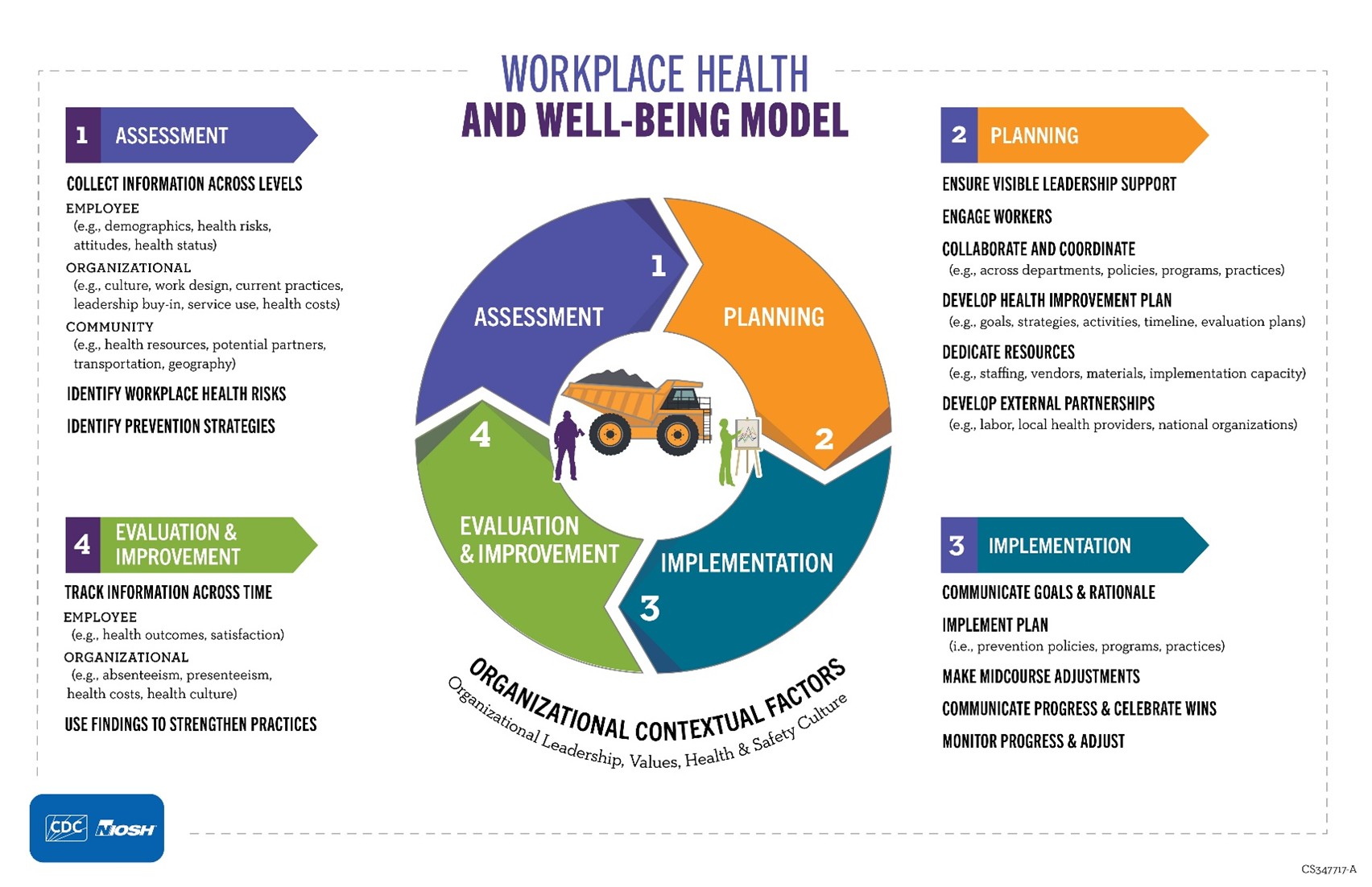
Figure 2. Workplace Health and Well-Being Model: Actions to Support Effectiveness of OUD Prevention. Adapted from the Workplace Health Model developed by the Centers for Disease Control and Prevention (CDC).
Employers in the mining industry can play a crucial role in improving the health and well-being of mine workers. Understanding the factors that contribute to increased risks of harmful opioid use, prescription misuse, OUD, and overdose is an important first step. Next steps include implementing evidence-based strategies to reduce harmful opioid use and facilitate workers’ access to prevention, treatment, and recovery supports. It is important for employers to tailor their prevention efforts to their organization’s unique needs and to integrate and evaluate efforts over time. Ultimately, encouraging workplace conversations about SUDs and potential solutions, particularly at the organizational level, will help to reduce stigma and increase access to treatment and recovery supports.
In this first iteration, the workplace guide is designed to provide resources for occupational safety and health professionals and others to plan and implement OUD/SUD prevention strategies. In the future, evaluation of this workplace guide is needed to inform improvements and development of additional supportive resources (e.g., toolbox talks, posters, get-started guide) tailored for employers. Evaluation efforts also will aid partners in identifying lessons learned and promising practices promoting greater uptake, use, and effectiveness of workplace prevention strategies.
Carol T. Nixon, MS, PhD, Research Health and Evaluation Scientist, Spokane Mining Research Division
Jamie C. Osborne, MPH, CHES®, Health Scientist, NIOSH Office of the Director
Kristin M. Yeoman, MD, MPH, Medical Epidemiologist, Spokane Mining Research Division
References
[i] National Center for Health Statistics, National Vital Statistics System. Provisional Drug Overdose Death Counts Retrieved November 14, 2025 from https://www.cdc.gov/nchs/nvss/vsrr/drug-overdose-data.htm.
[ii] Centers for Disease Control and Prevention (2024). Understanding the opioid overdose epidemic. Retrieved September 26, 2024 from https://www.cdc.gov/overdose-prevention/about/understanding-the-opioid-overdose-epidemic.html.
[iii] Hedegaard, H., Miniño, A. M., Spencer, M. R., & Warner, M. (2021). Drug overdose deaths in the United States, 1999–2020. NCHS Data Briefs, 428. http://dx.doi.org/10.15620/cdc:112340
[iv] NORC & National Safety Council. (n.d.). Substance Use Disorders by Occupation. Retrieved July 9, 2024 from https://www.nsc.org/getmedia/9dc908e1-041a-41c5-a607-c4cef2390973/substance-use-disorders-by-occupation.pdf
[v] Gu, J. K., Allison, P., Trotter, A. G., Charles, L. E., Ma, C. C., Groenewold, M., … & Luckhaupt, S. E. (2022). Prevalence of self-reported prescription opioid use and illicit drug use among us adults: NHANES 2005–2016. Journal of Occupational and Environmental Medicine, 64(1), 39.
[vi] Billock, R.M., Steege, A.L., & Miniño, A. (2023). Drug overdose mortality by usual occupation and industry: 46 U.S. states and New York City, 2020. National Vital Statistics Reports, 72(7), 1–34.
[vii] Shaw, W. S., Roelofs, C., & Punnett, L. (2020). Work environment factors and prevention of opioid-related deaths. American Journal of Public Health, 110(8), 1235–1241.
[viii] Asfaw, A., Quay, B., Bushnell, T., & Pana-Cryan, R. (2022). Injuries that happen at work lead to more opioid prescriptions and higher opioid costs. Journal of Occupational and Environmental Medicine, 64(12), e823–e832.
[ix] Dale, A. M., Buckner‐Petty, S., Evanoff, B. A., & Gage, B. F. (2021). Predictors of long‐term opioid use and opioid use disorder among construction workers: Analysis of claims data. American Journal of Industrial Medicine, 64(1), 48–57.
[x] Shaw, W. S., Roelofs, C., & Punnett, L. (2020). Work environment factors and prevention of opioid-related deaths. American Journal of Public Health, 110(8), 1235–1241.
[xi] NORC & National Safety Council. (n.d.). Substance Use Disorders by Occupation. Retrieved July 9, 2024 from https://www.nsc.org/getmedia/9dc908e1-041a-41c5-a607-c4cef2390973/substance-use-disorders-by-occupation.pdf
[xii] Goplerud, E., Hodge, S., & Benham, T. (2017). A substance use cost calculator for US employers with an emphasis on prescription pain medication misuse. Journal of Occupational and Environmental Medicine, 59(11), 1063–1071.
[xiii] Grossmeier, J., Fabius, R., Flynn, J. P., Noeldner, S. P., Fabius, D., Goetzel, R. Z., & Anderson, D. R. (2016). Linking workplace health promotion best practices and organizational financial performance. Journal of Occupational and Environmental Medicine, 58(1), 16–23.
[xiv] LaMontagne, A. D., Martin, A., Page, K. M., Reavley, N. J., Noblet, A. J., Milner, A. J., … & Smith, P. M. (2014). Workplace mental health: developing an integrated intervention approach. BMC Psychiatry, 14(1), 1–11.
[xv] Olson, R., Cunningham, T. R., Nigam, J. A. S., Anger, W. K., Rameshbabu, A., & Donovan, C. (2022). Total Worker Health® and Organizational Behavior Management: Emerging Opportunities for Improving Worker Well-being. Journal of Organizational Behavior Management, 43(4), 280–319.