When I first started working on AI products, I believed the hardest part would be getting the system to work.
Training a model. Producing accurate outputs. Making something impressive enough to demo. From the outside, that seemed like the real barrier between an idea and a company.
It turns out, that part is only the beginning.
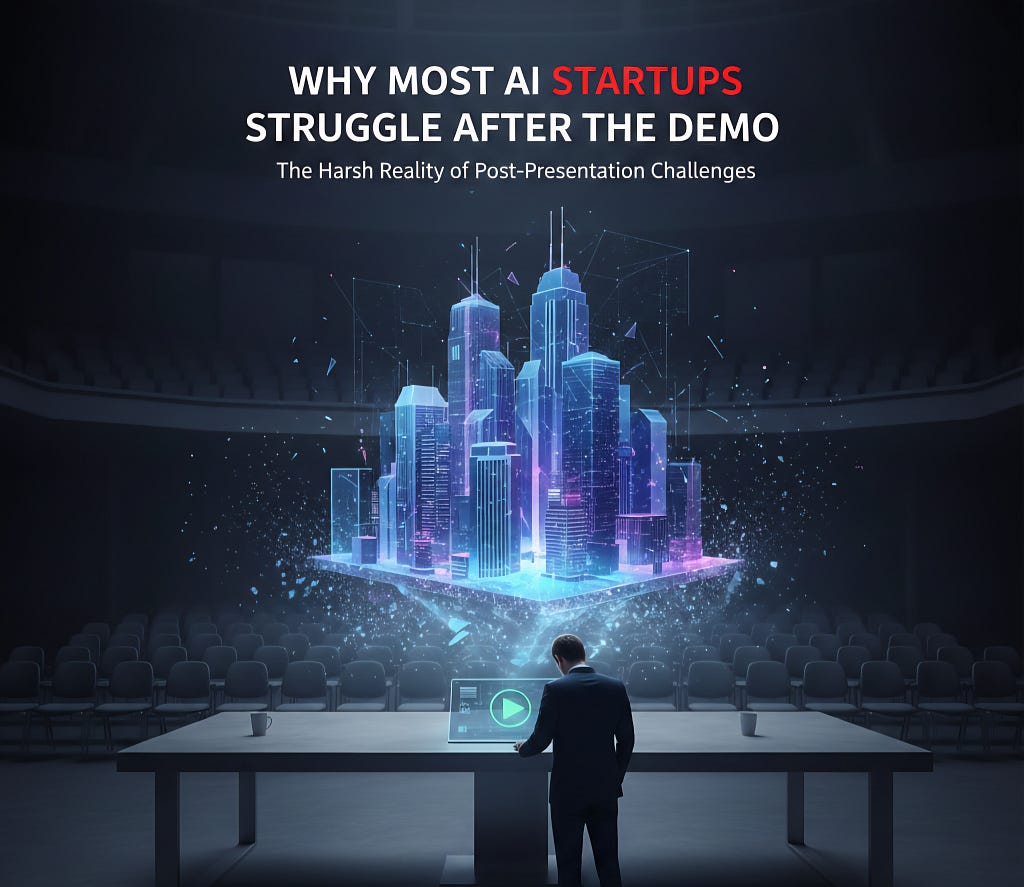
Most AI startups look strongest at the demo stage. Everything is controlled. Inputs are clean. Assumptions hold. The system behaves exactly as expected. Confidence is high, and it’s easy to believe you’re only a few steps away from something scalable.
But the moment an AI product moves beyond a demo, the ground starts shifting.
The first challenge usually isn’t technical brilliance — it’s unpredictability. Real users don’t behave like test cases. Data arrives messy, incomplete, or slightly different from what the system was trained on. Edge cases appear immediately, not gradually. Things that never broke during testing suddenly become recurring problems.
Then there’s integration. AI systems don’t live on their own. They sit inside products, workflows, and businesses that already have constraints. Payments, onboarding, compliance, customer expectations, support — all of these surface quickly once real users are involved. None of them show up in a demo.
This is where many AI startups start to slow down.
What I didn’t fully appreciate early on was how much of building an AI business has nothing to do with AI itself. The challenges shift from “Can we build this?” to “Can we operate this?” Reliability, trust, clarity, and consistency suddenly matter more than clever models or performance metrics.
Another issue is expectation mismatch. Demos create confidence — sometimes too much of it. Founders, customers, and even teams begin to assume that what works once will work repeatedly, at scale, under pressure. That assumption rarely holds without significant operational discipline.
Maintaining an AI system in the real world requires constant judgment. Knowing when to simplify instead of optimizing further. Knowing when to restrict features rather than expanding them. Knowing when to admit limitations instead of masking them with complexity.
These decisions don’t feel innovative, but they determine whether a startup survives.
I’ve noticed that the AI startups that last aren’t always the most technically impressive. They’re the ones that treat deployment as the start of the real work, not the finish line. They design systems with failure in mind. They expect change. They build processes around uncertainty rather than hoping it won’t appear.
Demos are necessary. They open doors. But they don’t prove durability.
The real challenge for AI startups begins after the demo, when the system has to earn trust every day, in environments that aren’t controlled and with users who don’t behave predictably.
That’s the part we don’t talk about enough. And it’s often the difference between an AI idea and an AI business.
About the author
Dr Shahroze Ahmed Khan is a founder and technologist focused on building real, deployable AI systems and intelligent software. He is the founder of OwnMind Labs and also leads RCC, a global education and consulting organization. His work explores the practical realities of building technology beyond demos and hype.
Why Most AI Startups Struggle After the Demo was originally published in Coinmonks on Medium, where people are continuing the conversation by highlighting and responding to this story.